Call for Papers
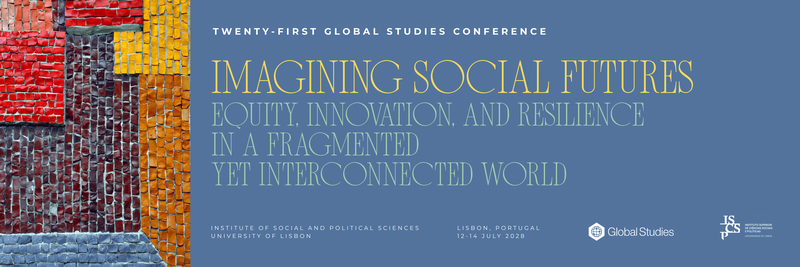
We invite you to join us for the Twenty-first Global Studies Conference, the annual meeting of the Global Studies Research Network, hosted by the Institute of Social and Political Sciences, University of Lisbon, taking place in Lisbon, Portugal and online, 12–14 July 2028.
The conference is part of a paired gathering with the Twenty-third International Conference on Interdisciplinary Social Sciences, bringing together overlapping communities of inquiry to examine how social and global futures are being imagined, contested, and built in a fragmented yet interconnected world.
The Global Studies Research Network is a leading international meeting place for scholars, practitioners, policymakers, educators, and community leaders working to interpret the patterns and disruptions of globalization. The Conference welcomes proposals that address globalization not only as a matter of international systems, but as a set of lived social, economic, political, cultural, technological, and ecological transformations.
Across the world, global systems are being reshaped by digital infrastructures, global mobility, transnational institutions, shared ecological and economic systems, geopolitical tension, migration, social inequality, and technological change. Key issues include global governance, trade and finance, human mobility, diaspora, digital societies, ecological interdependence, cultural exchange, social justice, human rights, and the uneven consequences of global transformation.
Special Focus and Themes
Imagining Social Futures: Equity, Innovation, and Resilience in a Fragmented yet Interconnected World
We meet at a moment of profound contradiction. The world is increasingly interconnected through digital infrastructures, global mobility, transnational institutions, and shared ecological and economic systems. At the same time, societies are experiencing political fragmentation, widening inequality, social polarization, democratic uncertainty, technological disruption, and renewed struggles over identity, belonging, and public life.
How can global studies help us understand these transformations? What kinds of futures are being imagined, designed, contested, or excluded across local, regional, and global contexts? How might research contribute to more inclusive forms of global governance, social organization, public policy, technological development, and collective life?
Hosted by the Institute of Social and Political Sciences at the University of Lisbon, the 2028 conference will explore the relationships among global interdependence, social imagination, institutional change, innovation, equity, and resilience. We welcome theoretically engaged, empirically grounded, practice-based, and interdisciplinary contributions.
Globalization has never produced a single shared future. It creates connections across economies, institutions, cultures, technologies, and ecologies, while also generating uneven risks, exclusions, vulnerabilities, and dependencies. In this context, imagining social futures means asking how global systems can be made more equitable, how innovation can serve human and ecological needs, and how societies can build resilience across borders, regions, and communities.
We welcome contributions addressing global futures as questions of economy, power, culture, mobility, ecology, governance, and social imagination.
Themes
- Equity, Inequality, and Global Justice: This theme explores how global systems produce, sustain, and challenge inequality. It invites work on poverty, development, labor, trade, human rights, racial justice, gender justice, migration, diaspora, global health, social movements, and the uneven distribution of resources, risks, and opportunities.
- Institutions, Governance, and Global Power: This theme explores how institutions, states, regions, non-state actors, and transnational systems shape global futures. It invites work on global governance, sovereignty, policy, law, international organizations, social movements, conflict, security, soft power, democratic practice, and the politics of interdependence.
- Innovation, Technology, and Cultural Transformation: This theme explores how technological, cultural, and social innovations reshape global relations. It invites work on digital societies, artificial intelligence, media, cultural exchange, global imaginaries, knowledge systems, education, communication, platform economies, and the cultural meanings of technological change.
- Resilience, Ecology, and Interconnected Futures: This theme explores how global communities respond to climate risk, ecological transformation, and shared vulnerability. It invites work on sustainability, climate justice, food systems, urbanization, environmental governance, disaster response, mobility, place, resilience, and ecological interdependence.
We also welcome proposals addressing the core themes of the Global Studies Research Network, including networks of economy and trade, the power of institutions, vectors of society and culture, and ecological foundations.
Knowledge Experience and Format
The conference is organized as a hybrid knowledge experience, integrating in-person and online participation within a unified scholarly environment.
For in-person delegates in Lisbon, the conference is designed as a human-scale gathering shaped by conversation, shared inquiry, and place-based exchange. Sessions, talking circles, breaks, and informal encounters create opportunities to connect global studies research with policy, professional practice, cultural analysis, institutional life, community knowledge, and the real-world systems that shape global change.
For online delegates, the conference is more than a remote viewing option. Accepted proposals become Presentation Pages where presenters share abstracts, media, and supporting materials. Delegates participate through live online sessions, asynchronous engagement, and discussion spaces that remain available before, during, and after the event.
Across both formats, the emphasis is on reciprocal exchange rather than one-way presentation. Whether joining in Lisbon or online, participants are part of a shared knowledge environment where ideas can be presented, discussed, revisited, and developed into future collaborations, publications, policy conversations, professional practices, and community initiatives.
Publication Pathways
Presenters are invited to further develop their conference work for possible publication in The International Journal of Interdisciplinary Global Studies, the peer-reviewed journal of the Global Studies Research Network.
Participants may also propose longer-form projects for the Global Studies Book Imprint, which publishes monographs and edited collections focused on global governance, transnational economies, migration and diaspora, cultural exchange, digital infrastructures, and ecological interdependence.
All accepted proposals are included in the conference proceedings, providing a formal record of the conference program and presentation abstracts. Proceedings help make presenters’ work discoverable as part of the annual knowledge record of the Research Network.
A Member-Based Research Community
The Global Studies Research Network is a member-based international research community connecting people working across economy, politics, culture, mobility, ecology, and global social change.
Membership provides year-round opportunities to participate in the life of the Research Network through conferences, publications, digital resources, and the CGScholar Community. Members receive access to Research Network content and publications, conference registration benefits, opportunities for continued learning and exchange, and pathways for developing and sharing their work.
The Community provides a space for members to maintain profiles, share projects, engage with other participants, revisit conference programs and recordings, and contribute to continuing conversations across the Research Network.
Membership in the Global Studies Research Network is included in all conference Presenter Passes.
Join Us
We warmly invite you to submit a proposal and join us, either in Lisbon or online, for the Twenty-first Global Studies Conference.
Together, we will examine how global social futures can be imagined, contested, and built with greater equity, innovation, and resilience in a fragmented yet interconnected world.
Sincerely,
Dr. Ricardo Ramos Pinto, Local Conference Committee, University of Lisbon, Lisbon, Portugal
Dr. João Ricardo Catarino, Local Conference Committee, University of Lisbon, Lisbon, Portugal
Dr. Rafal Soborski, Research Network Chair, Richmond American University London, United Kingdom
Dr. Phillip Kalantzis Cope, Chief Social Scientist, Common Ground Research Networks, United States of America